Discover.io
An AI-powered discovery platform that recommends tailored AI tools based on user context and workflows.
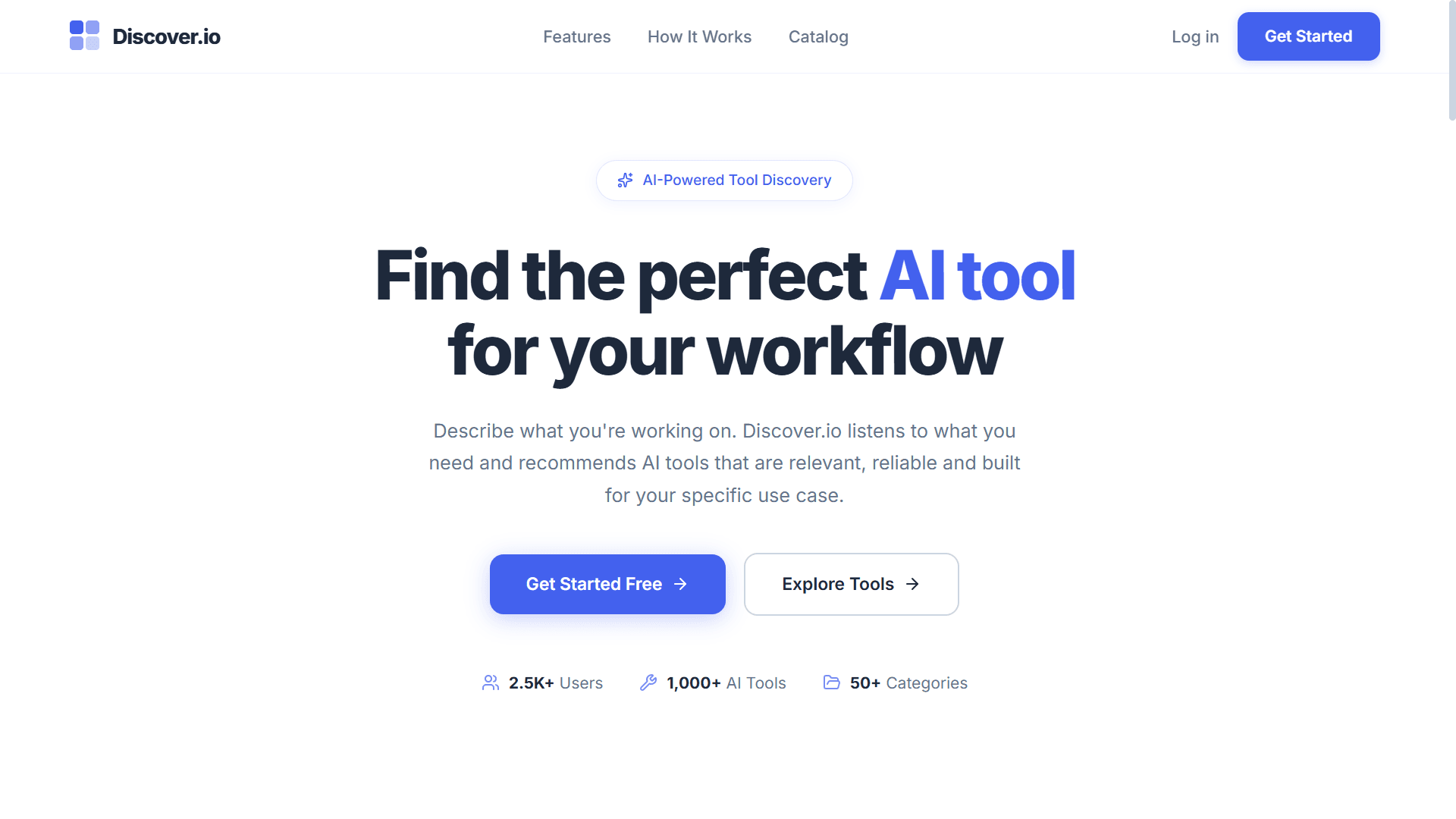
Discover.io solves the problem of finding reliable and context-specific AI tools in a crowded ecosystem. Unlike generic search engines, it acts as an intelligent discovery platform that listens to a user's specific problem, persona, and core task, clarifies the intent, and curates a ranked leaderboard of verified AI tools. It focuses on workflow integration, offering practical guidance and explicit trade-offs for each recommendation to help creative professionals work more efficiently.
The frontend is a Client-Side Rendered Single Page Application using React and Vite. TanStack React Query manages all asynchronous server state with efficient data caching, automatic retries, and seamless backend synchronisation. API client logic is decoupled from UI components via custom hooks built on Axios. The multi-step AI search flow (Input → Clarification → Confirmation → Results) is managed locally, leveraging Framer Motion for perceived zero-latency transitions between steps.
State Management
Chose
TanStack React Query for server state
Why
It provides built-in caching, background refetching, and robust error handling, which is crucial for managing variable response times from AI endpoints and preventing redundant network requests.
Trade-off
Requires stricter structuring of query keys and mutations compared to standard useEffect data fetching.
UX Flow
Chose
Multi-step 'Clarification' flow before executing AI searches
Why
AI recommendation engines often misinterpret generic queries. By explicitly extracting the User Persona, Core Task, and Success Criteria — and requiring user confirmation — the accuracy of recommendations improved drastically.
Trade-off
Added an extra confirmation step to the user journey in exchange for significantly higher-quality, context-driven results.
Build Tool
Chose
Vite over a full-stack framework like Next.js
Why
Vite provided lightning-fast HMR and optimised build times for an MVP that is strictly a Client-Side Rendered application interacting with external AI APIs.
Trade-off
Sacrificed out-of-the-box SEO optimisation and server-side routing capabilities, which may necessitate a migration if organic SEO becomes a primary growth vector.
Migrate to Next.js for Server-Side Rendering to improve public SEO indexing of the skills and tools catalog
Implement streaming responses (Server-Sent Events) for AI interactions to further reduce perceived latency during the Diagnosis phase
Introduce persistent user profiles to cache onboarding data for long-term personalised recommendations